
Under canvas
Camping in Kidepo Valley National Park
Camping is how most people actually experience Kidepo, not a cheaper add-on to a lodge stay. Between the government-run rest camp at Apoka and two public campsites out on the Narus circuits, you can sleep inside one of Uganda's wildest parks for a fraction of what the one full-service lodge charges, provided you arrive ready to be entirely self-sufficient.
If you only want the answer
You can camp at Apoka Rest Camp in a self-catering banda or with your own tent, or at one of UWA's public campsites, Kakine and Nagusokopire, on the Narus circuits for UGX 40,000 per person a night, a rate the tariff only quotes in shillings so confirm the foreign-visitor price when you book. Two further categories, wilderness sites at $40 per person and advance-booking private sites at $30, exist on UWA's national tariff, but nothing published ties them to named spots at Kidepo, so ask UWA directly if one interests you. Booking runs through reservations@wildlife.go.ug or the toll-free line 0800 100 960, full payment is required up front since March 2026, and the online portal is not functioning, so email is the reliable route, though self-drivers who can't finish the paperwork in advance sometimes settle the details on arrival at Apoka. Bring everything: there is no fuel, no shop and no confirmed treated water once you pass Kitgum.
The ways to camp at Kidepo
UWA's national conservation tariff prices camping in three categories, A, B and C, but its Kidepo-specific material only ties Category C to two named public sites, Kakine and Nagusokopire. It does not state which of Kidepo's spots, if any, are sold as Category A wilderness or Category B private, so if one of those tiers appeals, ask UWA to confirm it actually applies here before you plan around it. Separately, Apoka Rest Camp offers government-owned bandas, and by all indications takes tents too, at rates the tariff does not publish for Kidepo at all.
| Option | Where | Rate | What is actually there |
|---|---|---|---|
| Apoka Rest Camp, banda | Apoka headquarters, Narus Valley | Unpublished, ask UWA | 21 twin bandas, 14 self-contained, plus a 4-bedroom guesthouse; self-catering, no mains power |
| Apoka Rest Camp, own tent | Same headquarters site | Unpublished, ask UWA | Camping ground at park headquarters, rangers and guides on hand |
| Category C public campsite | Kakine and Nagusokopire, Narus circuits | UGX 40,000 pp | Pit latrine, water, firewood and a shelter provided; foreign-visitor rate ambiguous, confirm at booking |
| Category A wilderness campsite | Not specified for Kidepo | $40 pp | Ranger guide included, maximum 16 people; no other facilities listed |
| Category B private campsite | Not specified for Kidepo, advance booking | $30 pp | Maximum 20 people; facilities not listed, ask what's provided |
Student groups pay UGX 3,000 per person at the public sites. None of these figures include the daily park entrance fee, which is charged separately per person and per vehicle.
Apoka Rest Camp: the cheapest beds inside the park, or a place to pitch your own tent
The budget way to sleep inside Kidepo is government-owned, refurbished bandas at Apoka headquarters, now run under concession by Footprints Safaris. It is self-catering with no restaurant and no mains power, so bring your own food, cooking gear, and a plan for light and charging once the sun goes down. What it lacks in comfort it makes up in position, in the middle of the Narus Valley game country with rangers and guides on the doorstep, and zebra, hartebeest and reedbuck wandering the camp surroundings.
UWA's tariff accommodation table omits Kidepo entirely, so no official banda rate is published anywhere we could find; the same goes for pitching your own tent on the same headquarters ground. Ask reservations directly for the current price of both before you book, since neither is the same product as the Category C public campsites out on the circuits.
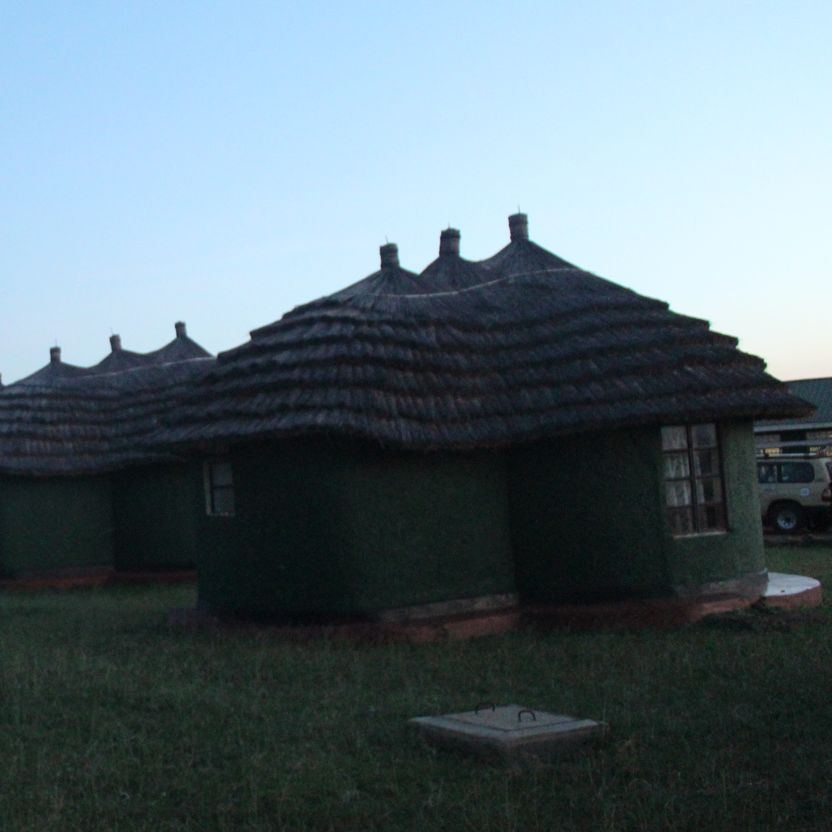
The Narus circuit campsites: Kakine and Nagusokopire
Kakine and Nagusokopire are UWA's named Category C public campsites, out on the same Narus circuits as the game drives, and they are the cheapest legitimate way to sleep inside the park. Kakine's viewpoint takes in a 360-degree panorama across the Napore-Nyungea range, the Morungule mountains and Mount Lomej in one sweep, which makes it worth requesting on its scenery alone.
Facilities are basic but real: a pit latrine, water, firewood and a shelter are provided at both, per UWA's tariff. What the tariff doesn't state is each site's maximum capacity, unlike Category A and B, which publish 16 and 20 respectively, so ask when you book if you're travelling as a larger group.
The rate is UGX 40,000 per person per night, but that figure is quoted only in shillings, with no published dollar equivalent for foreign visitors. Confirm the actual amount you'll be charged when you book rather than assuming a straightforward currency conversion applies.
How UWA booking works in 2026
There is no live online booking system for Kidepo camping, and the tariff's own portal was not functioning when we last checked, so the reliable route runs through people rather than a webpage.
- 1. Decide what you want: a banda or your own tent at Apoka, or a Category C site at Kakine or Nagusokopire. If a wilderness or private site elsewhere in the park interests you, ask whether it applies to Kidepo at all.
- 2. Email reservations@wildlife.go.ug, or call or message the toll-free line 0800 100 960, with your dates, party size, vehicle details and which option you want, in order of preference.
- 3. Since 1 March 2026, UWA requires full payment at the time of booking; the earlier practice of holding a reservation for seven days without payment has been suspended. Be ready to pay as soon as availability is confirmed.
- 4. Payment itself is cashless: mobile money (MTN MoMo or Airtel Money), a POS card machine, or bank transfer are all listed on the current tariff.
- 5. Bring your confirmation, printed or saved offline. Phone signal is unreliable on the approach roads and inside the park, and the gate will want to see it.
What we can't fully confirm is how strictly the pre-payment rule is enforced for self-drivers heading to Kidepo specifically. The official position is full payment in advance by email or phone, but with the online system down, several self-drive accounts describe finishing the paperwork, or settling payment, once they reach Apoka rather than entirely beforehand. Treat emailing ahead and paying in advance as what UWA expects, and being ready to pay at Apoka as a fallback that clearly exists in practice, not as the plan itself.
The email, ready to copy
This gives UWA reservations everything they need in one message:
“Hello, I would like to book camping at Kidepo Valley National Park. Dates: [arrival] to [departure], [x] nights. Party: [x] adults, [x] children with ages. Vehicle: [x], [type and country of registration]. Preferred option: [Apoka Rest Camp banda / Apoka Rest Camp, own tent / Kakine / Nagusokopire], with [second choice] as a backup. Nationality or residency for the park and camping fee tiers: [foreign non-resident / foreign resident / East African citizen]. Please confirm the total, including the daily conservation fee and vehicle fee, and how you would like it paid.”
One addition worth including if it applies to you: ask whether a UWA ranger guide is included in your camping fee or charged separately, since the tariff only states that explicitly for Category A wilderness sites.
Provisioning: Kitgum is your last stop
There is no fuel anywhere in or near Kidepo, no shop, and no mains power at Apoka. On the western approach, Kitgum is the park's own last major town, the tar ends there and it is the last dependable fuel; treat it the same way for food, drinking water, cooking gas or charcoal, and ice. On the eastern Karamoja approach, Kotido plays the same role.
Because Apoka Rest Camp is self-catering and none of the public campsites have a shop, plan every meal and your full drinking-water supply before you leave Kitgum or Kotido. Category C sites provide firewood, but nothing published says how much, and Category A, Category B and the Apoka camping ground don't list firewood at all, so carry a stove as your guaranteed way to cook and treat any provided firewood as a bonus rather than the plan.
Lion and hyena discipline: camping in an unfenced park
None of Kidepo's camping options are fenced. Apoka Safari Lodge's own listing describes the valley beneath it as unfenced, and the rest camp and public campsites sit on the same open ground.
Kidepo's lion population has collapsed to roughly 12 animals across the whole park, per a 2022 survey, so the odds of one walking through camp are low. Spotted hyena are more likely, mostly active at night, and buffalo, elephant and baboon all move through the Narus circuits where Kakine and Nagusokopire sit.
The discipline is simple and non-negotiable: keep all food sealed in your vehicle or a proper container overnight, never in your tent or left out; baboons and hyena both investigate an unattended camp. Use a torch and check around you before you step outside your tent at night. Do not walk beyond the campsite boundary after dark without a ranger, the same rule that governs every guided walk in the park. Keep your fire going as one more layer, and put it out properly before you sleep. Zip your tent fully, every time, even for a short trip to the vehicle.
Bandas versus your own tent: which suits you
First-time Kidepo visitors, or anyone new to camping in big-game country, should take a banda at Apoka. You still self-cater and still have no mains power, but you get four walls, a door that locks, and rangers and guides at headquarters within walking distance. It is also, right now, the only way to sleep inside Kidepo without owning or hiring full camping gear.
Fully self-sufficient travellers with a 4x4, your own tent, and the discipline to run a proper camp should look at Kakine or Nagusokopire instead. Both put you further out on the Narus circuits, closer to the game and the silence, for a fraction of the banda rate. Ask for Kakine if the mountain panorama matters to you as much as the wildlife.
Either way, this is not a park to arrive at without a plan. Confirm your booking, your payment, and your fuel and water supply before you leave Kitgum, not after.
Something this page does not answer?
Campsite booking in these parks is rarely a website. If you cannot work out who to write to, ask us.
Ask us. We answer questions about the park itself, and we can usually tell you which camps work on one route and who to write to. If what you want is a trip someone else arranges, we will say so and hand you to an operator we know, and we earn a commission if that becomes a booking.
Nothing on this site sits behind the form. Every figure we have is already on the page.