
The full field guide
Wildlife in Kidepo Valley National Park
Uganda's buffalo stronghold, a recovering population of Critically Endangered Nubian giraffe, elephant herds that roam across two borders, and more than 475 bird species. This page follows UWA's own 2026 science, which corrects a surprising amount of what the internet says about Kidepo.
If you only want the answer
Kidepo runs on the Narus valley: the only reliable water pulls buffalo herds in their thousands, lion, elephant and giraffe onto one floor you can watch from a rock at Apoka. Around it live the Karamoja specials, ostrich first among them, that occur nowhere else in Uganda.
What the valley holds, and what it lost
Green means the Narus Valley delivers it, amber means possible, terracotta means you would be among the few. UWA's brochure claims 86 mammal species while its website says 77, so treat the exact count as unsettled. What is settled is the pattern: in the dry months everything concentrates on the remnant pools of the Narus Valley, and that is where these odds apply.
- Buffalo Guaranteed Massive Narus swamp herds
- Warthog Guaranteed Abundant around Apoka
- Olive baboon Guaranteed
- Vervet monkey Guaranteed
- Nubian giraffe Guaranteed 163 animals on the dry Narus slopes
- Jackson's hartebeest Very likely Open Narus grassland
- Oribi Very likely
- Zebra Very likely One of only four Ugandan parks with them
- Waterbuck Very likely Near the remnant Narus pools
- Elephant Very likely Herds also range outside the park
- Spotted hyaena Good chance Mostly nocturnal
- Bushbuck Good chance Shy, riverine thicket
- Dik-dik Good chance Crepuscular and secretive
- Greater kudu Good chance Only ~206 in all Uganda
- Uganda kob Good chance Reintroduced, still establishing
- Lion Takes luck ±12 in the whole park
- Leopard Takes luck Nocturnal; 328 nationally
- Lesser kudu Takes luck Very shy, dense bush
- Caracal Takes luck No wild population data exists
- Bat-eared fox Takes luck Wild status unconfirmed
- Striped hyaena Takes luck Wild status unconfirmed
- Aardwolf Takes luck Possibly absent
- Cheetah Takes luck Likely functionally absent
- Wild dog Takes luck One sighting in 40 years
- Beisa oryx Not here Extinct in Uganda since 1983
- Roan antelope Not here Locally extinct; survives only in Pian Upe
Chances reflect a typical three-night dry-season stay. In the wet months from April to October the game disperses off the Narus circuits and the odds drop. Species silhouettes from PhyloPic (CC0, CC BY and CC BY-SA).
Buffalo: the reason Kidepo was protected
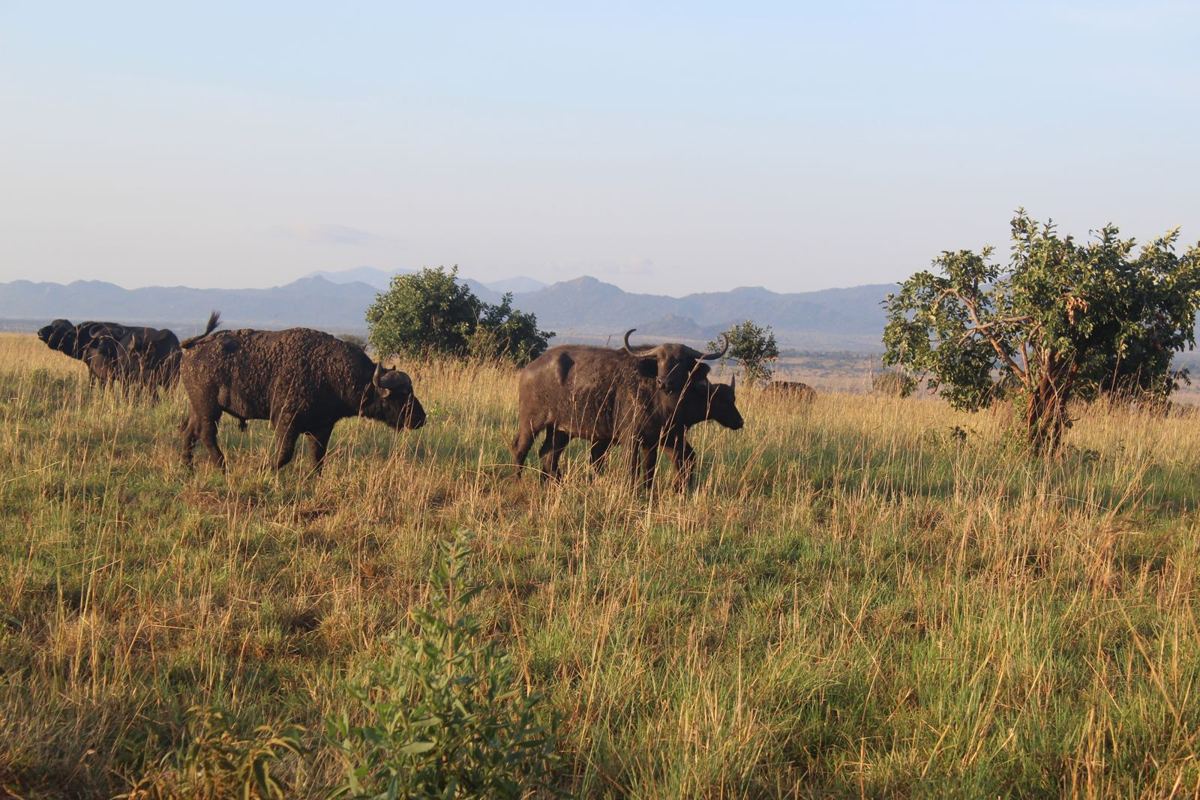
The park was created in 1962 largely to protect its big herds, and buffalo remain the signature. UWA's 2026 State of Wildlife Resources report states plainly that Kidepo Valley National Park is the main buffalo stronghold in Uganda, within a national population of 41,548 that has been growing at almost nine per cent a year.
UWA's park page puts Kidepo's own herds at 10,000 to 15,000. No park-specific survey figure has been published, so treat that range as UWA's claim rather than a count. What is beyond dispute is the spectacle: in the dry season the Narus swamps carry buffalo congregations that are the largest single sight in the park.
Lions: the honest numbers
Here is the correction that matters most. The figure of around 132 lions that most Kidepo articles still quote dates from 2009. A survey conducted between August and December 2022 estimated roughly 12 lions remaining, a decline of about 91 per cent in 13 years, driven by poisoning linked to livestock predation, snaring, trade in lion parts and habitat pressure. Uganda's national lion population fell to 291 in the same report.
One caveat belongs alongside that number: the estimate used call-up and spoor methods, and in Queen Elizabeth National Park a later individual-identification study found substantially more lions than call-up surveys had suggested. Twelve may be an undercount. But nobody defends the old figure, and no honest guide should promise you lions in Kidepo. If you see the famous rock-climbing lions on the Narus outcrops, count it as the luck it is.
Nubian giraffe: a real recovery story
Kidepo's giraffe were nearly lost in the 1990s. By 2025 the population had rebuilt to 163 animals, helped by 14 giraffe translocated from Murchison Falls in 2018, and sightings on the dry slopes above the Narus Valley are now close to certain.
Two updates most guides have missed. First, the taxonomy changed in 2025: Uganda's animals are now classified as the Nubian giraffe, which is Critically Endangered, and the old name Rothschild's giraffe is outdated even though UWA's own website still uses it. Second, the number: UWA's site still says 'over 50', which is a fraction of the real figure.
Elephants that ignore the borders
UWA puts Kidepo's elephants at 650 to 1,000, up from around 200 in the 1990s, within a national population of 6,352. The in-park number fluctuates for an interesting reason: Kidepo's elephants have established permanent ranges outside the park in Karamoja, where they are not counted, and collared animals have crossed into Kenya.
For visitors that means elephant are likely rather than guaranteed on any given drive, and it means the park sits at the centre of a real human-wildlife conflict zone, with crop-raiding a serious issue for neighbouring communities.
The famous 'only in Kidepo' list, checked against the science
Almost every Kidepo article repeats a line from a 2018 brochure: that this is Uganda's only home of the cheetah, bat-eared fox, striped hyaena, caracal and aardwolf. We searched UWA's own 190-page State of Wildlife Resources in Uganda 2026 report, and the list does not survive contact with it.
Cheetah and aardwolf receive zero mentions in the entire report. Bat-eared fox and striped hyaena appear only in a captive-animal inventory at a private facility hundreds of kilometres away. None of the four is documented as a wild Ugandan population. They may persist in Kidepo's remote north in small numbers, and the dry-country habitat is right, but present them as long-shot possibilities, not drawcards.
Beisa oryx is worse: UWA lists it as extinct in Uganda, with the last records in 1983, and those were in Bokora and Matheniko rather than Kidepo. Roan antelope is also locally extinct in Kidepo, surviving in Uganda only in Pian Upe. On the brighter side, a pair of African wild dogs was seen near the Narus River in June 2023, the first confirmed record in Uganda in over 40 years, though it is unknown whether they were resident or passing through.
What genuinely is special here: eland occur in only two Ugandan parks, Kidepo and Lake Mburo, with Kidepo holding 127; greater and lesser kudu are essentially Karamoja specialities; and this is one of just four Ugandan protected areas with zebra.
Birds: over 475 species, second only to Queen Elizabeth
UWA records over 475 bird species, a Ugandan list second only to Queen Elizabeth's 604, including more than 100 dry-country residents found nowhere else in the country and 56 species of raptor. The semi-arid thornbush brings in Kenyan and Ethiopian specialities that no other Ugandan park offers.
Beyond the top five, look for secretary bird and ostrich on the Kidepo Valley drive, Abyssinian roller and red-throated bee-eater around Apoka, and lappet-faced vulture, Denham's bustard and lesser kestrel over the plains. Ranger birding guides are available at Apoka for $25 per person per walk.
- Common ostrich Kidepo's northern plains are the classic place to see wild ostrich in Uganda; they also occur in Pian Upe, whatever the brochures say
- Kori bustard Africa's heaviest flying bird, striding the open Narus and Kidepo grasslands
- Abyssinian ground hornbill Huge, terrestrial and red-throated, walking the savanna in pairs
- Karamoja apalis One of only two bird species endemic to Uganda, and a genuine Karamoja speciality
- Clapperton's francolin A dry-country francolin essentially confined in Uganda to the Kidepo region
Where to look, valley by valley
| Area | Best for |
|---|---|
| Narus Valley circuits (Kakine, Katurum, Nagusokopire) | The core game area: buffalo in the swamps, giraffe on the drier slopes, lions on the rock outcrops when luck runs your way |
| Apoka surroundings | Zebra, hartebeest, reedbuck and warthog on foot with a ranger; the short walks start here |
| Kidepo Valley drive, 30 km north | Scenery first, then ostrich and secretary bird; short on big game but the landscape is the point |
| East Kakine walking area | Giraffe, buffalo and elephant on longer guided walks, with lion possible at a distance |
| Morungole foothills | Mountain scenery, dry-country birds and the Ik community villages above |